

Sometimes… ok, more than sometimes, I wonder What am I actually practicing for?
Is it to master “martial technique”, to chase external validation of rank, just for fun, to blow off some steam?
Or is it to touch something more elusive—achieving fleeting somatic fusion, facilitating fluid grace in motion?
Who knows? But, On this episode, I had the pleasure of hosting a guest who brings a refreshing perspective to these exact inquiries: Elizabeth Anaya.
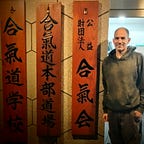
Elizabeth currently trains at the Kongoshinkan Dojo in Norwalk, Connecticut.
What makes her perspective uniquely compelling (to me) is her rich experience as violinist (or fiddler, depending on the gig), educator, and certified Suzuki music teacher.
As a Suzuki educator, her teaching is rooted in the revolutionary philosophy of Shinichi Suzuki, who, I learned, designed a formalized methodology to teach playing the violin as a native language—focusing on breaking down highly complex, unforgiving physical tasks into smaller, more manageable steps fostered by a supportive environment.
During our talk, Elizabeth shares a story from Suzuki’s foundational book, Nurtured by Love, that perfectly mirrors the slow, patient cultivation of Shugyo on the mat. She recounted how, hstorically, young warriors in training were instructed to plant a fast-growing hemp seed and jump over the sprout every day.
As the plant grew incrementally, the student’s physical capacity grew alongside it, allowing them to eventually jump high in the air without feeling such a sharp, sudden, overwhelming barrier.
This “growth mindset” is how Elizabeth approaches both music education and her own Aikido practice. She elegantly bridges the gap between the demanding world of classical pedagogy and gently persuasive creative exploration.
As Aikidoka, we’re constantly navigating the tension between polished technical forms (composition) and the spontaneous flow of Jiyu Waza (improvisation). Very similar to music…
Elizabeth shares her personal experience of preparing for a recent test where she had to execute a total free response for the first time, learning how to drop her analytical, calculating mind to let her body simply react and flow.
We also spoke with raw honesty about the physical realities and bodily compromises that come with years of intensive training. Elizabeth candidly discussed how her knees have “changed” over the past year to the point where sitting in Seiza or practicing Suwari waza for more than twenty seconds causes intense discomfort.
This sparked a vital conversation about how Aikido organizations structure their grading requirements, and whether the community needs to do a better job of adapting to modern practitioners’ physical limitations so that the art remains a source of life-long well-being rather than joint-destroying attrition.
Are we training to become feudal warriors? Or to alleviate stress, regulate our nervous systems, and fine tune the alignment between mind and body?
I’ll also let you in on a bit of a behind-the-scenes secret:
Elizabeth hosted a successful podcast of her own for years. When we first scheduled this recording, I fully intended to pick her brain and steal all her secrets. However, once I hit record, our conversation immediately took off into such deeply fascinating waters that I never actually got around to it.
Additionally, you might notice that the last 5 minutes of our conversation is missing from the audio. God only knows what digital glitch gremlin devoured those final moments, but fret not—(that’s a music joke, get it? fret?)—I plan on asking Elizabeth to come back on the show very soon so we can continue our dialogue and (hopefully) discuss making me more adept at the art of podcasting!
“Ki to the City” remains entirely reader-supported. If you draw inspiration from these conversations and wish to help me keep this podcast on the airwaves, please consider signing up as a paid subscriber.
If you would prefer to make a one-time contribution to support our production, you can email me directly at jondiluca@yahoo.com. As a token of my immense gratitude, you will receive a complimentary copy of Don Dickie Sensei’s beautiful and deeply reflective volume of poetry, Silent Winds of Aikido.


